13 Week Cash Flow Template
A quarter of Fridays, one column each: the forecast you build when the monthly view is too coarse to tell you whether next week's payroll clears.
Who this page is for
You are not planning a year — you are managing the next three months week by week. Typical situations: a big client is paying late and you still have payroll; you are funding a season before the harvest or the launch; you have a payment plan with a supplier or a tax authority and must not miss a date; or you are simply running thin and want to see the wall before you hit it.
In all of those, a monthly forecast is too blunt. Money that arrives on the twenty-eighth and payroll that leaves on the twenty-fifth look identical in a monthly column, and the difference is the entire problem.
Why thirteen weeks
Thirteen weeks is one quarter, divided into weeks. It is short enough that you can name the actual customers and payments behind every line, and long enough to cover a full cycle of invoicing, collection and payroll. The horizon rolls: each week you drop the week that has passed and add a new thirteenth week, so the sheet never becomes a historical document.
That rolling discipline is the real feature. A twelve-month forecast is something you build; a thirteen-week forecast is something you operate. It is the standard tool in cash-tight businesses for exactly that reason — it forces you to look at the near term every week, with named counterparties, instead of once a quarter with averages.
What a weekly forecast has to contain
- Opening cash, week one, by account. Read from the bank and cash, dated. Not an estimate.
- Receipts by customer and invoice. "Client A, invoice 114, due 12 Nov, expected 19 Nov, 4,200." Named lines let you chase the specific payment instead of watching a total sag.
- Disbursements by payee and date. Payroll and its tax, rent, suppliers, loan instalments, card payments, tax remittances. Put the actual day of the week in, because a Friday payroll and a Monday transfer are different risks.
- Weekly net and closing balance. Closing = opening + receipts − disbursements, carried to the next week by formula.
- A variance line per week. Planned versus actual, filled when the week closes. This is how the forecast improves instead of repeating the same optimism.
- A minimum-balance flag. Conditional formatting that turns red when a closing balance drops below your safety floor. The point of the exercise is to see the breach two weeks early.
Where the free templates stop
The measured results for this query are thin and mostly generic: spreadsheet-suite templates and bank or vendor freebies built around a monthly cash flow, relabelled for weeks. Two failures follow. First, the buckets are not real weeks — they are monthly figures divided by four, which destroys the whole reason for a weekly view. Second, there is no rolling mechanism: you get a static thirteen columns and no habit of shifting them.
Free files also tend to omit the two lines that matter most in a tight quarter: tax remittances and debt service. Miss those and the forecast looks comfortable right up to the week it is not.
Setting it up, step by step
- Fix week one. Choose the Monday (or your payroll week start) and write the date. Thirteen columns, each labelled with its week-ending date, real dates so the sheet can be sorted and filtered.
- Enter opening cash per account — bank, card, cash — and sum them. This is the only number in the file that is a fact rather than a forecast.
- Build the receivables schedule first. Export your open invoices, then for each one write the expected week of collection. Use your actual collection history per client, not the terms printed on the invoice.
- Build the payables schedule next. Same treatment in reverse: supplier bills with due weeks, payroll dates, rent, loans, tax. Anything with a fixed date goes in its exact week.
- Compute the chain. Weekly net, then closing balance, then next week's opening referencing it. Lock the formula cells.
- Set the safety floor and a conditional format that flags any closing balance below it. Choose a floor you actually need, not a round number that feels brave.
- Operate it. Every week: enter actual receipts and payments, note the variance, roll the window forward by one week, re-check the thirteen-week horizon. Ten minutes, same day each week.
- Escalate while there is time. If week six is red, the useful moves — call the client, delay a purchase, agree a payment date — are still available. At week one they are not.
Mistakes that turn the forecast into fiction
- Spreading monthly numbers evenly across weeks. Payroll is not a quarter of the month; it is one Friday. Smoothing hides exactly the week you needed to see.
- Forecasting collections as if invoices were paid on time. Use the lag you observe. The gap between terms and behaviour is where surprises live.
- Leaving out tax and debt. Sales tax collected is not available cash, and a loan instalment does not disappear because it is annoying.
- Never rolling the window. A thirteen-week sheet that stays on the same thirteen weeks becomes a museum piece by week fourteen.
- Treating the closing balance as a promise. It is a scenario. The value is in the decisions it triggers, not in the number itself.
Frequently asked questions
Questions below are the actual search phrasings from Google Suggest (US), measured 2026-10-26.
- 13 week cash flow model — why thirteen and not twelve?
- Thirteen weeks is a full quarter: four weeks per month plus the extra days. Ending the horizon on the quarter boundary keeps the weekly sheet aligned with monthly reporting, so the last column lands where the month closes.
- 13 week cash flow template — monthly or weekly buckets?
- Weekly, or it defeats the purpose. Monthly averages hide the week when payroll and a supplier payment collide. If your source data is monthly, split it by actual due dates rather than dividing by four.
- 13 week cash flow template Excel — how do I roll it forward?
- Enter the week's actuals, delete the oldest week's contents, insert a new column at the right, and copy the formulas across. Lock the chain cells so the new week's opening balance references the previous closing balance rather than a typed number.
- 13 week cash flow model example — which lines belong in it?
- Opening cash by account; receipts by customer and invoice; disbursements by payee and date — payroll and its tax, rent, suppliers, loans, tax remittances; weekly net and closing balance; variance against last week's plan. Anything you would notice missing belongs; anything below your materiality threshold does not.
- Rolling 13 week cash flow forecast — how often should it be updated?
- Every week, on a fixed day, in about ten minutes: actuals in, one week rolled. The rhythm matters more than the template — a perfect model updated quarterly is a historical document with a future tense.
- Best practices 13 week cash flow forecast — what do they have in common?
- Named counterparties instead of category averages, real due dates instead of even spreads, tax and debt service treated as first-class lines, a safety floor that turns red early, and a variance habit that makes next month's forecast less optimistic than this month's.
When you need the weekly view inside the books
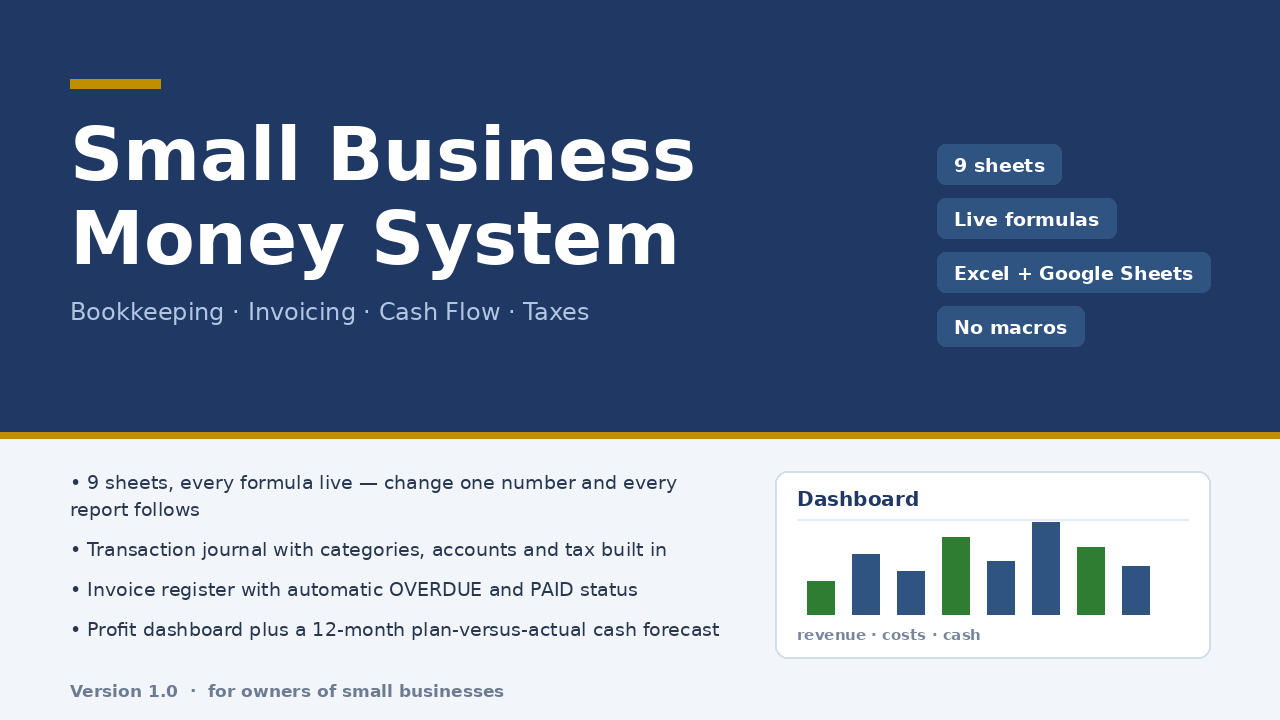
A weekly forecast is only as good as the payables and receivables feeding it — which means it needs a book behind it. Micro-Business Money System provides that book: a 300-row journal as the single source of money, a 60-row invoice register where status and days overdue are computed by formula (so the receivables schedule writes itself), a dashboard, a 12-month plan-versus-actual cash flow, and a tax estimate. Nine sheets, no macros, ten minutes of setup, $47 once.
Honest limits: the workbook is a 12-month monthly cash flow, not a 13-week weekly grid — the weekly sheet is a separate exercise you build on top, and this page describes how. The file does not connect to a bank. It was verified by formula engine and an independent model (22 structural checks, 85 number reconciliations, zero discrepancies) but not opened in a desktop Excel during checking; verify dropdowns after importing into Google Sheets. Tax figures are estimates at your own rate, not advice.
Read the full description — $47 once
On Getly the workbook is in the shop ZRN Tools — Small Business Spreadsheets; the listing is still in the marketplace’s review queue, so its own page is not public yet — this block becomes the direct purchase link as soon as it is approved.